
Mineral Ingredient Specifications are the blueprint of your product’s success. Whether you are producing high-end PVC pipes, brilliant white paints, or durable adhesives, the quality of your calcium carbonate is the deciding factor in your production efficiency. At HERBOCAL, we believe that an informed buyer is our best partner. When you know exactly what to ask, you ensure that your production line stays profitable and your product quality remains world-class.
In modern manufacturing, success is not accidental—it is engineered.
Whether you are producing high-performance PVC pipes, premium decorative paints, advanced coatings, or industrial adhesives, the foundation of your product lies in one critical factor: the quality and precision of your raw materials.
Among these materials, Ground Calcium Carbonate (GCC) plays a central role. In many applications, it represents the largest component by weight, making its specifications a direct driver of:
- Product performance
- Production efficiency
- Cost structure
- Equipment longevity
This is why Mineral Ingredient Specifications should never be treated as a simple technical document—they are the blueprint of your entire production system.
An informed buyer is not just purchasing material; they are protecting their operation from risk and unlocking long-term value.
This guide outlines the 10 essential questions every procurement manager and R&D engineer must ask before selecting a GCC supplier.
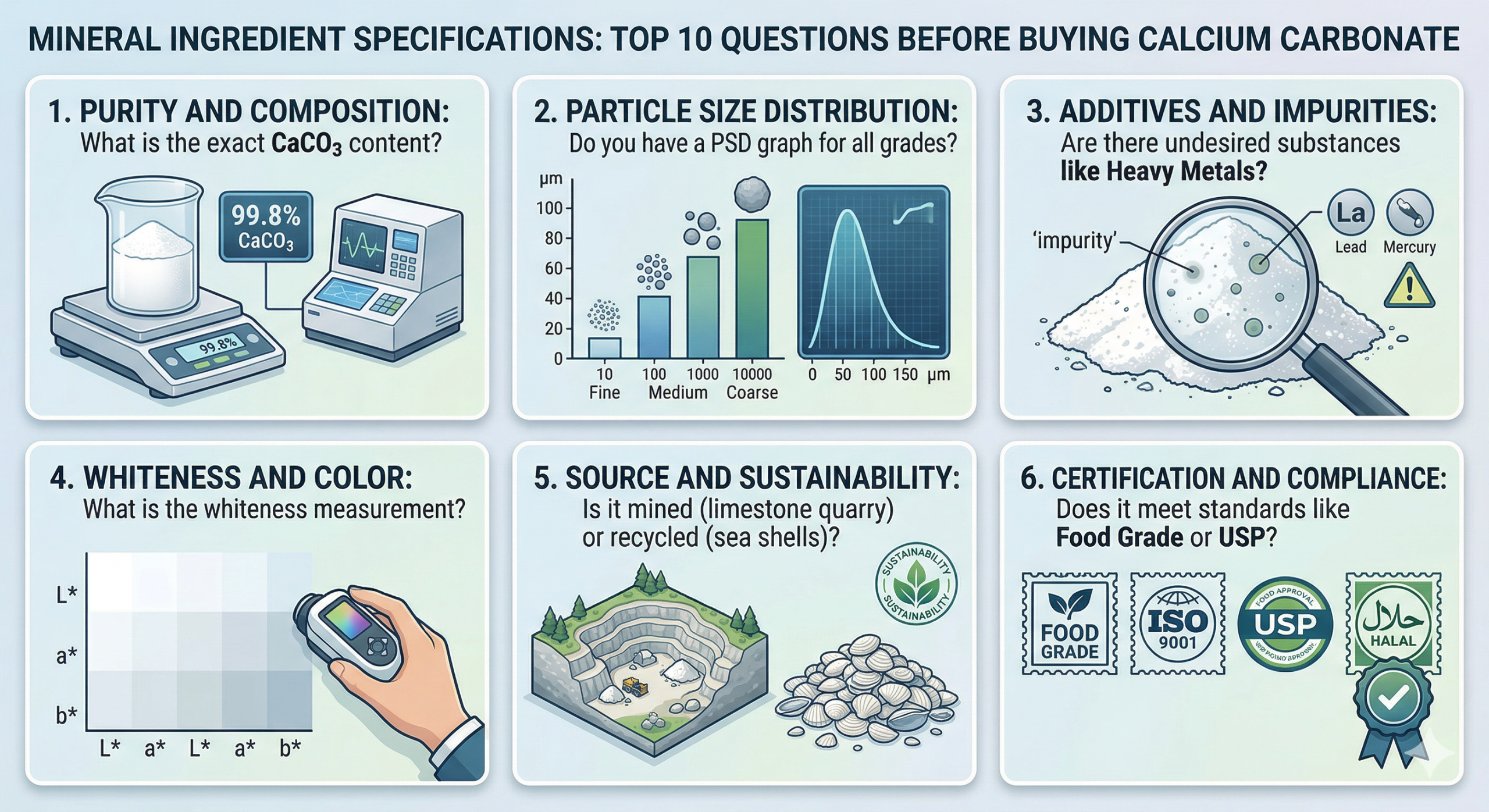
Mineral Ingredient Specifications: Top 10 Questions to Ask Before Buying Calcium Carbonate
1. What is the Exact CaCO₃ Purity Level?
The first and most fundamental parameter is chemical purity.
Why It Matters
Low-purity calcium carbonate introduces unwanted minerals such as silica, magnesium, and iron, which can:
- Interfere with chemical stability
- Affect product color and finish
- Reduce performance consistency
Benchmark Standard
High-quality GCC should offer:
- CaCO₃ purity above 98–98.5%
Impact on Production
Higher purity means:
- Cleaner formulations
- Fewer side reactions
- More predictable results
2. What is the Whiteness and Brightness Index?
In industries such as paints, coatings, and plastics, whiteness is more than aesthetics—it is a cost optimization tool.
Key Metrics
- Brightness (Ry)
- Lightness (L*)
Why It Matters
Higher brightness allows:
- Reduction in Titanium Dioxide (TiO₂) usage
- Improved color accuracy
- Enhanced visual appeal
Target Range
- Brightness levels of 96–98% are considered premium
3. Can You Provide a Full Particle Size Distribution (PSD)?
Average particle size alone is not enough.
Critical Parameters
- D50 (median particle size)
- D97 (top cut)
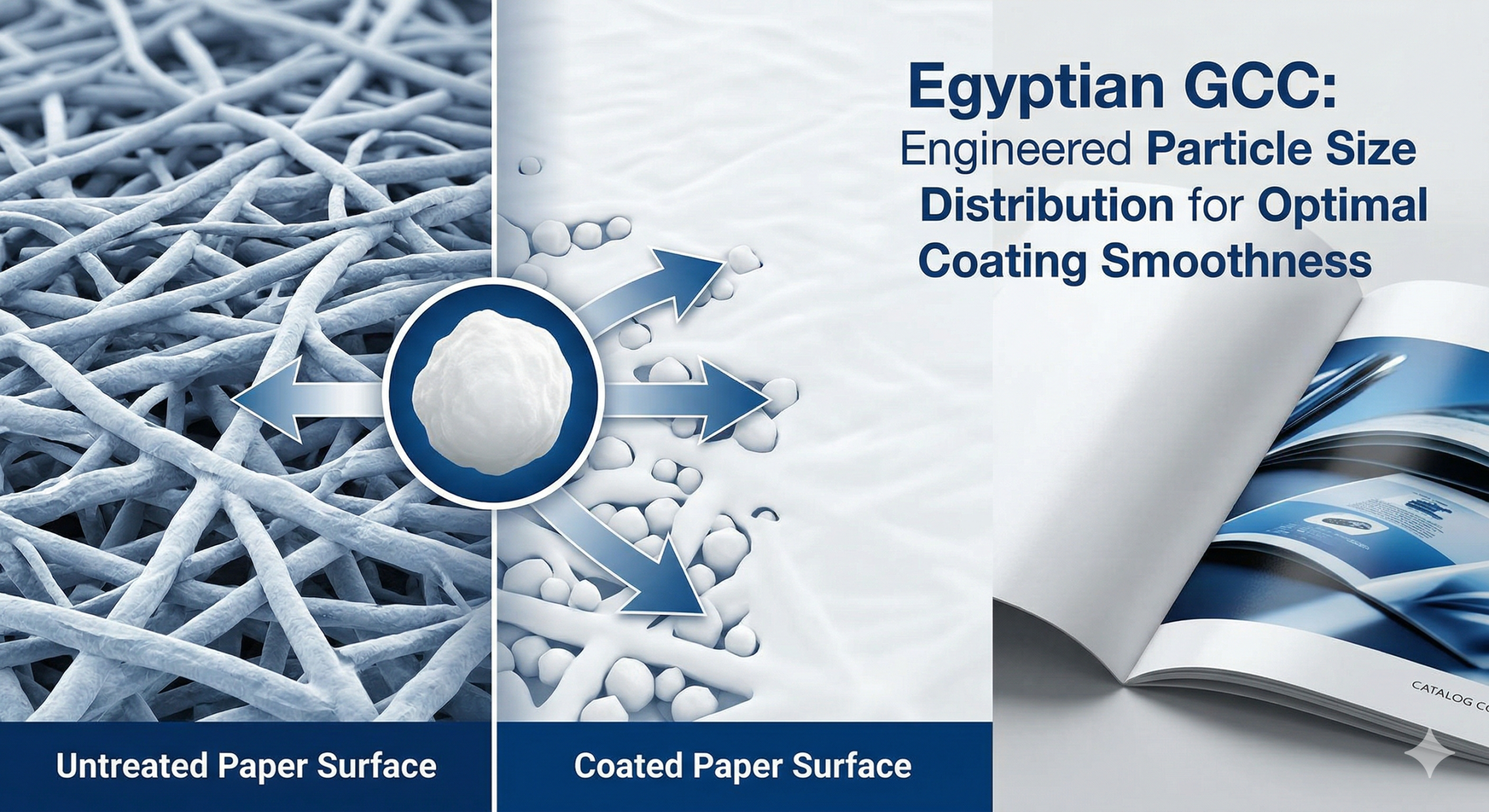
Why PSD is Crucial
Particle size affects:
- Surface smoothness
- Mechanical strength
- Optical properties
- Processing behavior
Risks of Poor PSD Control
- Gritty textures in coatings
- Weak films in plastics
- Inconsistent product quality
What to Expect
A reliable supplier should provide:
- Detailed PSD charts
- Tight distribution ranges
- Consistent micron-level accuracy
Mineral Ingredient Specifications: Top 10 Questions to Ask Before Buying Calcium Carbonate
4. What is the Oil Absorption Value?
This is one of the most underestimated yet critical specifications.
What It Indicates
Oil absorption measures how much binder (resin or plasticizer) is required to wet the mineral surface.
Why It Matters
High oil absorption leads to:
- Increased raw material costs
- Higher viscosity challenges
- Reduced formulation efficiency
Optimal Performance
Low and stable oil absorption allows:
- Reduced binder usage
- Better flow and processing
- Improved cost efficiency
5. How is Moisture Content Controlled?
Moisture is a hidden risk in many industrial processes.
Common Problems Caused by Moisture
- Bubble formation
- Surface defects
- Weak mechanical properties
- Processing instability
Target Specification
- Moisture content below 0.2%
What to Verify
- Drying technology used
- Storage and packaging conditions
- Stability during transport
6. Is the Material Coated or Uncoated?
Surface treatment significantly affects performance in polymer systems.
Coated GCC
Typically treated with stearic acid to:
- Improve dispersion
- Enhance compatibility with polymers
- Increase processing efficiency
Uncoated GCC
Used in:
- Paints and coatings
- Water-based systems
- Applications requiring high reactivity
Key Question
Can the supplier customize coating levels to match your application?
7. Is a Certificate of Analysis (COA) Provided with Every Batch?
Consistency is the foundation of industrial reliability.
What a COA Should Include
- Chemical composition
- PSD data
- Brightness levels
- Moisture content
Why It Matters
A COA ensures:
- Traceability
- Quality assurance
- Confidence in batch-to-batch consistency
Without it, you are operating blindly.

Mineral Ingredient Specifications: Top 10 Questions to Ask Before Buying Calcium Carbonate
8. What are the Silica Content and Abrasiveness Levels?
This specification directly impacts your equipment.
The Hidden Cost of High Silica
- Increased wear on machinery
- Frequent maintenance
- Reduced equipment lifespan
Ideal Scenario
- Low silica content
- Low Mohs hardness (~3)
Business Impact
Lower abrasiveness means:
- Reduced maintenance costs
- Longer machine life
- Higher operational efficiency
9. What are the Lead Time and Logistics Capabilities?
Even the best material is useless if it does not arrive on time.
Key Considerations
- Supplier proximity to ports
- Shipping routes and reliability
- Experience in international logistics
Why It Matters
- Prevents production delays
- Reduces inventory pressure
- Improves supply chain resilience
10. Do You Offer Technical Support and Application Expertise?
The final—and most important—question separates suppliers from partners.
Why Technical Support Matters
Industrial formulations are complex. Challenges require expertise, not just materials.
What a True Partner Provides
- Formulation optimization
- Application-specific recommendations
- Troubleshooting support
- Continuous improvement strategies
The Real Value
Technical collaboration leads to:
- Faster problem-solving
- Better product performance
- Reduced development costs
Quick Benchmark Table: Ideal GCC Specifications
| Specification | Target Value | Why It Matters |
|---|---|---|
| CaCO₃ Purity | > 98.5% | Ensures chemical stability |
| Brightness | 96–98% | Reduces pigment costs |
| Moisture | < 0.2% | Prevents defects |
| PSD Control | Tight D50/D97 | Ensures consistency |
| Oil Absorption | Low | Reduces binder usage |
| Hardness (Mohs) | ~3 | Protects machinery |
| Specific Gravity | ~2.7 g/cm³ | Accurate formulation |
Conclusion: Specifications Are Strategy
Mineral Ingredient Specifications are not just technical details—they are strategic tools.
They determine:
- How efficiently your factory runs
- How consistent your product is
- How competitive your business becomes
By asking the right questions, you:
- Eliminate risk
- Optimize costs
- Ensure long-term operational stability
The difference between average and exceptional manufacturing often comes down to how well you understand—and control—your raw materials.
If you want to take control of your production performance and ensure your formulations meet the highest global standards, start by upgrading your raw material strategy.
Work with a supplier who can:
- Provide full transparency
- Deliver consistent, high-purity GCC
- Offer technical expertise tailored to your application
Reach out today to discuss your Mineral Ingredient Specifications and discover how precision-engineered calcium carbonate can elevate your entire production system.