
Raw Material Uniformity: Why Consistency in GCC Supply is the Key to Manufacturing Success In industrial manufacturing, unpredictability is not just inconvenient—it is expensive.
Whether you operate a high-speed extrusion line, a large-scale paint facility, or a precision adhesive plant, your entire operation depends on one critical factor: consistency. Machines are calibrated, formulations are optimized, and production schedules are engineered around a single assumption—that your raw materials will behave exactly the same every time.
This is where Raw Material Uniformity becomes the silent engine of operational excellence.
Ground Calcium Carbonate (GCC), one of the most widely used industrial fillers, plays a central role in this equation. When GCC varies—even slightly—in particle size, moisture, or chemical composition, the consequences ripple across your entire production process.
This guide explores why consistency is the most valuable specification you can demand from a supplier—and how leading manufacturers secure it as a competitive advantage.

Raw Material Uniformity: Why Consistency in GCC Supply is the Key to Manufacturing Success
1. The Cost of Inconsistency: Why “Close Enough” Fails in Industry
Many suppliers can deliver a “good” batch of GCC.
Very few can deliver the same batch—every time, at scale.
Without Raw Material Uniformity, manufacturers expose themselves to three major operational risks:
Machine Downtime and Recalibration
Industrial equipment is highly sensitive to material behavior.
Even small deviations in:
- Particle Size Distribution (PSD)
- Moisture content
- Surface treatment
can force operators to stop production and recalibrate machines.
Impact:
- Lost production hours
- Increased labor costs
- Reduced throughput
Production Waste and Off-Spec Output
Inconsistent GCC leads directly to inconsistent products.
Examples include:
- Brittle PVC pipes
- Overly viscous or unstable paints
- Films that tear during processing
- Adhesives with weak bonding strength
Result:
Rejected batches, wasted raw materials, and reduced profitability.
Brand and Market Reputation Risk
End users expect consistency.
If your product performance varies due to filler inconsistency:
- Color deviations appear
- Mechanical properties fluctuate
- Application performance becomes unreliable
Over time, this erodes customer trust and damages brand positioning.
2. Uniformity Begins at the Source: Geological Consistency Matters
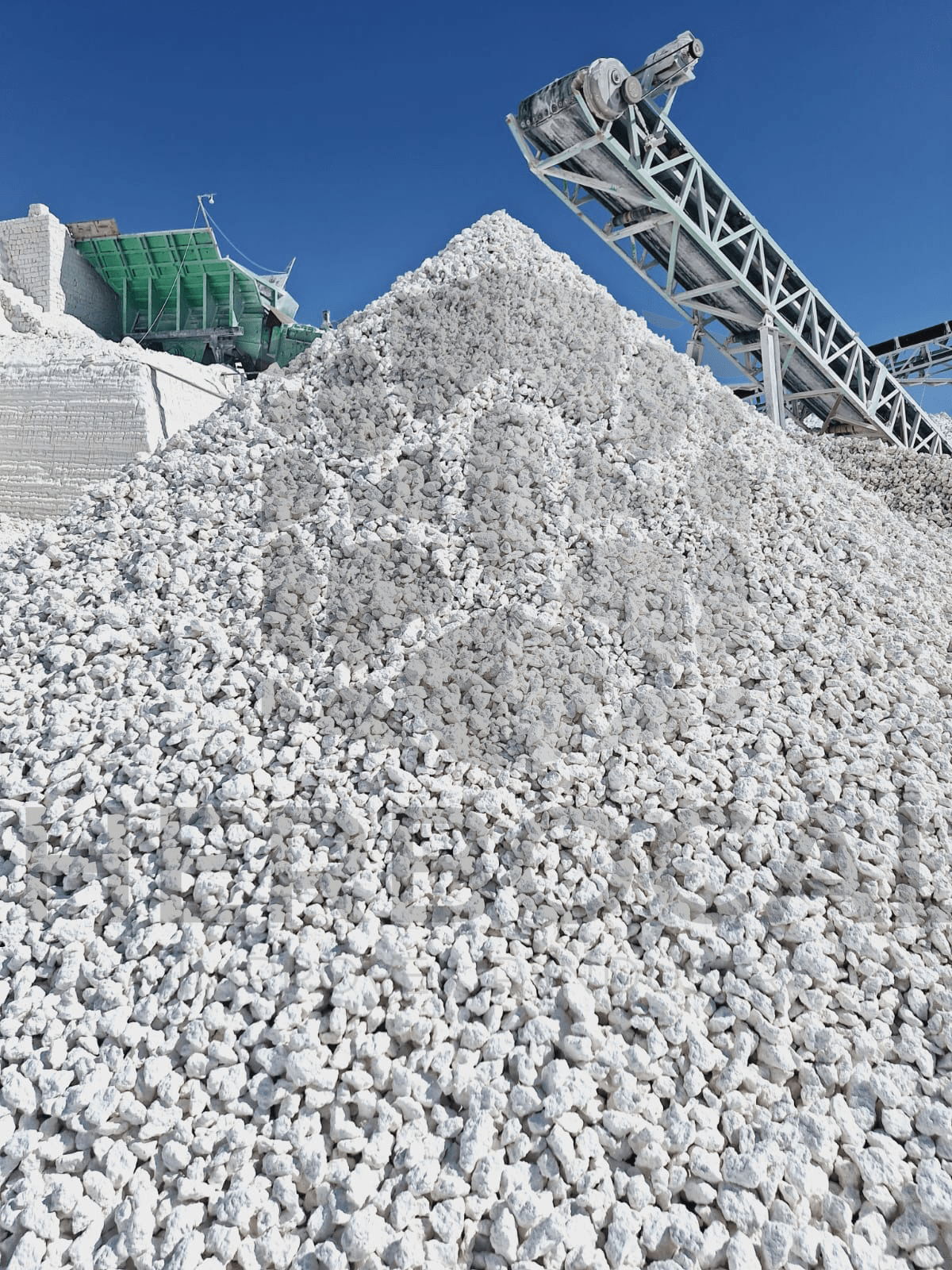
Raw Material Uniformity does not start in the factory—it starts in the quarry.
Countries like Egypt are globally recognized for their high-purity limestone reserves, particularly in regions such as Samalut.
Why Geological Stability Is Critical
Not all limestone deposits are equal.
In many regions, mineral composition varies across layers, leading to:
- Fluctuating CaCO₃ purity
- Inconsistent impurity levels
- Variable optical properties
The Advantage of Homogeneous Deposits
Stable geological formations provide:
- Consistent chemical composition (>98.5% CaCO₃)
- Minimal variation in whiteness
- Predictable downstream processing
Strategic Insight
When the raw stone is uniform, every step that follows becomes more controllable.
Uniform input → Uniform processing → Uniform output.
Raw Material Uniformity: Why Consistency in GCC Supply is the Key to Manufacturing Success
3. Processing Precision: Where Technology Ensures Consistency
Even the highest-quality limestone cannot guarantee uniformity without advanced processing.
The Role of Modern Milling Systems
State-of-the-art grinding and classification technologies allow manufacturers to precisely control:
- Particle size distribution
- Top cut (D97)
- Median size (D50)
Why Precision Matters
Variations in particle size can cause:
- Surface defects in coatings
- Poor dispersion in polymers
- Inconsistent viscosity in formulations
Controlled Particle Distribution
A tightly controlled PSD ensures:
- Smooth processing
- Stable rheology
- Consistent product performance
Moisture Control: The Overlooked Variable
Moisture is one of the most underestimated threats to uniformity.
Excess moisture leads to:
- Bubble formation in plastics
- Poor adhesion in coatings
- Storage and handling issues
Maintaining moisture levels below 0.2% is critical for stable production.
4. Laboratory Discipline: Engineering Consistency Through Data
True Raw Material Uniformity is not achieved through inspection—it is engineered through systems.
The Quality Control Loop
A robust QC system operates across three stages:
1. Raw Material Verification
Each incoming batch of limestone is tested for:
- Chemical purity
- Whiteness
- Impurity levels
2. In-Process Monitoring
During production:
- PSD is continuously measured
- Equipment settings are adjusted in real time
- Deviations are corrected immediately
3. Final Product Validation
Before shipment:
- Full laboratory analysis is conducted
- Key parameters are verified:
- Brightness
- Oil absorption
- Moisture
- Particle size
The Role of Certification
A Certificate of Analysis (COA) provides:
- Batch-specific data
- Performance assurance
- Full traceability
Many leading manufacturers align their processes with standards from the International Organization for Standardization to ensure consistency and accountability.
5. The Formulation Advantage: Consistency Unlocks Optimization
For R&D teams, Raw Material Uniformity is not just operational—it is strategic.
Why Chemists Depend on Consistency
When material properties are stable, formulations can be optimized to their limits.
Practical Optimization Examples
- Stable brightness enables reduction of Titanium Dioxide usage
- Predictable oil absorption allows precise resin dosing
- Consistent PSD ensures repeatable viscosity and flow
Result
- Lower formulation costs
- Reduced safety margins
- Higher production efficiency
Consistency transforms formulation from approximation into precision engineering.
Raw Material Uniformity: Why Consistency in GCC Supply is the Key to Manufacturing Success
6. Supply Chain Uniformity: Consistency Beyond the Material
Uniformity is not فقط about the product—it is also about availability.
The Risk of Supply Instability
Switching suppliers due to shortages can introduce:
- New material behaviors
- Reformulation requirements
- Production delays
Strategic Logistics Advantage
Suppliers located near global trade routes—such as the Suez Canal—can maintain steady international supply flows.
What Reliable Supply Looks Like
- Consistent delivery schedules
- Scalable production capacity
- Long-term availability of the same grade
Key Insight
Supply consistency protects formulation consistency.
7. The Uniformity Benchmark: What World-Class GCC Looks Like
To evaluate a supplier’s reliability, manufacturers should benchmark consistency across key parameters:
| Parameter | Why It Matters | Target for Uniformity |
|---|---|---|
| Whiteness (Ry) | Prevents color variation | Stable at 96%–98% |
| D97 (Top Cut) | Controls surface smoothness | Minimal deviation |
| Oil Absorption | Affects resin consumption | Low and consistent |
| Moisture | Prevents defects | ≤ 0.2% |
| CaCO₃ Purity | Ensures chemical stability | ≥ 98.5% |
Consistency across these metrics is the true indicator of supplier excellence.
Conclusion: Consistency Is the Ultimate Competitive Advantage
In modern manufacturing, efficiency is no longer enough—predictability is the real advantage.
Raw Material Uniformity allows manufacturers to:
- Eliminate unexpected disruptions
- Reduce waste and downtime
- Optimize formulations with confidence
- Deliver consistent product quality to the market
In contrast, inconsistent materials introduce hidden costs that compound over time.
Final Thought
The difference between a reactive factory and a high-performance operation lies in the reliability of its inputs.
When your raw materials are consistent, your entire business becomes more stable, efficient, and profitable.
If your production team is constantly adjusting machines, correcting formulations, or dealing with inconsistent results, the issue may not be your process—it may be your raw material.
Choose a partner who delivers:
- Verified batch-to-batch consistency
- Advanced processing control
- Reliable global supply
- Full technical transparency
Secure your production stability by making Raw Material Uniformity your top priority—and transform consistency into a long-term competitive edge.
related news & insights.
Mineral Filler Optimization: A Buyer’s Guide to Comparing GCC Grades and Specifications
Strategic Mineral Partnerships: Key Factors That Define a Reliable GCC Supplier